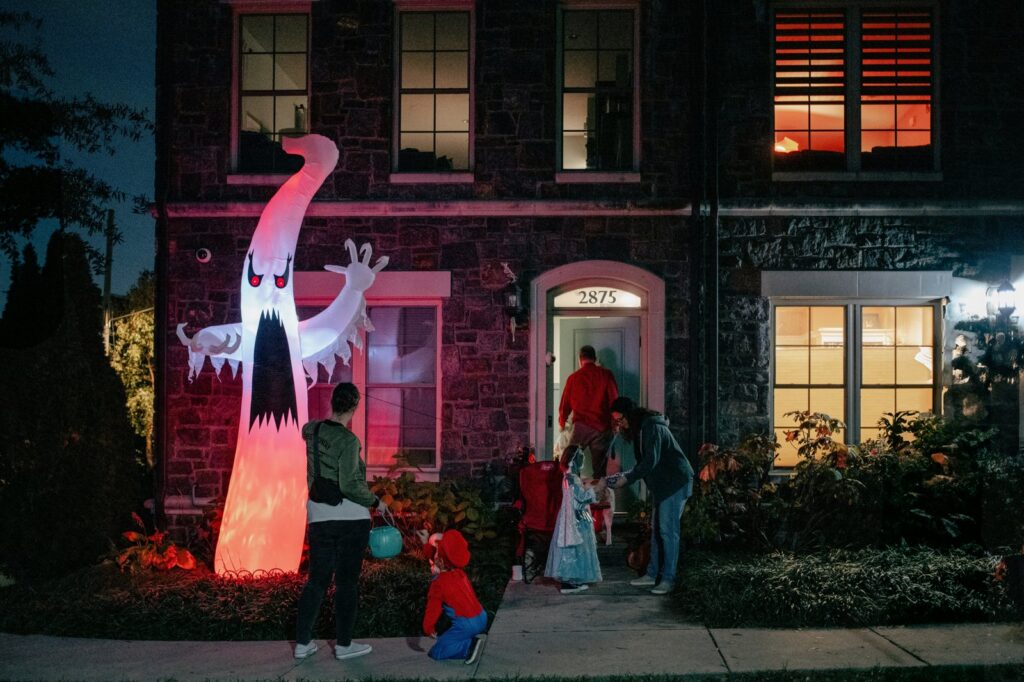
The story begins with a night when the living and the dead were thought to stand close. What unfolded over centuries is a long drift from vigils and prayers for departed souls to the door-to-door candy run Americans know on 31 October.
From Samhain to All Hallows’ Eve
Halloween is All Hallows’ Eve, the night before the Western Christian feast of All Hallows’ Day. It opens Allhallowtide, the season for remembering saints, martyrs and the faithful dead. Where it came from is still argued. One theory ties many of its customs to Samhain, the Gaelic festival that marked the end of the harvest and the start of winter, a moment when the boundary with the Otherworld was thought to thin. Other scholars say it began on its own as a Christian vigil.
Either way, the holiday was kept in Ireland and Scotland for centuries. Irish and Scottish immigrants carried many of its customs to North America in the 19th century, and American influence then spread them further by the early 21st.
Souls, soul cakes and disguises
Trick-or-treating has older roots. On All Souls’ Day, 2 November, poor people, often children, went door to door in parts of England, Wales, Flanders, Bavaria and Austria. They collected soul cakes and prayed for the dead in return, usually for the givers’ own friends and relatives. The custom was called souling, and it dates back at least to the 15th century. Guising, the wearing of costumes, came from a similar world of belief.
Costumes have their own explanations. The minister Prince Sorie Conteh linked them to the old belief that departed souls wandered until All Saints’ Day, so people put on masks to avoid being recognised by a ghost seeking revenge. Lesley Bannatyne notes that in the Middle Ages, churches too poor to display relics let parishioners dress as saints.
Haunted Oaks, Woodbury
Today the holiday is a mix of costume parties, pumpkin carving, haunted attractions and decorating, and it is among the most popular days of the year in the United States. In Woodbury, Minnesota, you can see what that looks like on one set of streets.
Royal Oaks, a neighborhood built in the 1960s for employees of the nearby 3M headquarters, is known in October as The Haunted Oaks. More than 100 houses decorate, and no two displays are alike. Residents liken it to a slice of Salem in the Midwest. As original owners downsized and moved out, younger families moved in. In 2019 a handful of neighbors teamed up on their displays, and it grew from there.
Shelly Ahrens grew up in deep rural Minnesota, where decorating made little sense with no one around to see. Now she lives on a corner in a neighborhood that loves the holiday. “You can’t be classy on Halloween,” she said. “We just keep adding and adding and adding because people keep coming.”
Derek Schmidt, a lead organizer, says no one was ever told to decorate. People just added on year after year, and some have moved in to join. About 2,200 trick-or-treaters came in 2025, and organizers expect more this year. For the first time the city agreed to close the streets to traffic on Halloween night. Schmidt compares the parking and traffic to a Minnesota Vikings game at U.S. Bank Stadium.
The event is free, so organizers have had to find money for police overtime and for renting nearby school parking lots. What is left goes into a candy fund, which guarantees any resident who cannot afford to take part at least one big bag. Local bars have named drinks after the event and donated part of the proceeds. “We’re just a bunch of homeowners that decorate,” Schmidt said.
Joe Briol and his husband John Pundsack have lived there since 1996, when 50 trick-or-treaters was a good night. They now count visitors and run wagonloads of candy to houses that are nearly out. Sarah Anderson’s pumpkin wall holds more than 70 foam pumpkins. Katie Rust built the haunted afterlife of flight 1031 around a real Cessna borrowed from a local boneyard. The public can visit every evening through Halloween, with lights and animatronics on until 9 p.m.
The risk on the road
The fun carries a hard statistic. The American Red Cross says children are more than twice as likely to be struck and killed by a vehicle on Halloween as on any other day of the year, citing the Journal of the American Medical Association. Its advice is plain. Trick-or-treaters should be easy to see and able to see where they are going, and should visit only homes with porch lights on. Drivers should take extra care after dark, since many costumes are hard to spot at night.
Alcohol-related crashes also rise around the holiday, and many Halloween traffic deaths involve impaired drivers. In Royal Oaks, volunteers will be out with wagons of candy on the night, and the streets will be closed.
Sources
- Halloween
- This Woodbury neighborhood draws thousands of visitors for its Halloween displays
- Q&A: How to Have a Fun and Safe Halloween
Photo: Nils Huenerfuerst / Unsplash (Unsplash License)