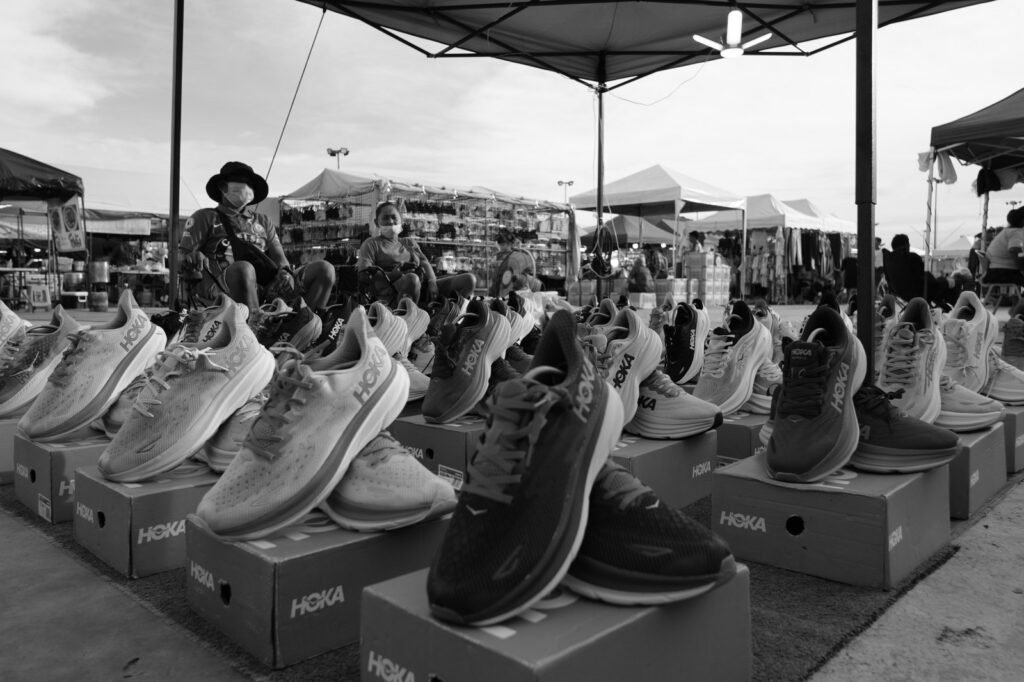
The story begins on the shelves, where Hoka sneakers recently turned up at Nordstrom with up to 50 percent off. At Hoka’s parent, Deckers Brands, the mood is different. The brand is not discounting, yet it is finally feeling the pressure of a market that is.
Shoppers wait for the sale
Stefano Caroti, Deckers’ president and chief executive, told analysts on the second-quarter fiscal 2027 earnings call on Thursday that promotional activity rose throughout the quarter, especially in athletic footwear. It weighed on the company’s US e-commerce performance as Deckers stuck to selling at full price.
“We also observed two shifts in consumer behavior,” Caroti said. “Consumers increasingly seeking discounts, concentrating traffic around promotional events, and consumers becoming more purposeful in their spending and prioritizing products with immediate relevance and utility.”
Winners and misses
Hoka’s core franchises did well, led by the Bondi. The Clifton Pro, a well-received extension of the Clifton line, helped. Some other franchise updates in calendar 2026, Caroti said, “did not resonate as well,” according to feedback from shoppers and wholesale partners. Pressed by an analyst, he named the Transport, Kawana and Solimar, which “didn’t go as planned.” The Speedgoat 7, Arahi 9 and Stinson 8 were “doing very well across the marketplace.”
He called the feedback a chance to improve from spring 2027, and said he was very encouraged by what Hoka president Robin Green and her team had put together for spring/summer and fall 2027.
The numbers
Deckers’ net sales in the quarter rose 3.5 percent to $1.48 billion from $1.43 billion a year earlier. Net income for the three months ended September 30 climbed 16.8 percent to $313.1 million, or $2.31 a diluted share, against $268.2 million, or $1.82, a year before. Hoka’s own net sales reached $677.2 million, up 6.8 percent from $634.1 million.
The outlook was cut all the same. Deckers now expects fiscal 2027 net sales of $5.70 billion to $5.73 billion, down from earlier guidance of $5.86 billion to $5.91 billion. “Growth is never a straight line,” Caroti said. “And in this environment, we don’t want to trade brand equity for short-term revenue.”
A wider price ladder
At its heart, the plan to stay at full price means widening the range in both directions, “broadening access while elevating the pinnacle of the brand.” Two launches are due in the first half of 2027. The Fly Pace sneaker arrives in January at $115 to “welcome a new consumer” into Hoka. In June comes the Bondi Ultra X at $325, billed as the brand’s softest, most cushioned ride.
For a company that began in 2009 in Annecy, France, when former Salomon employees Nicolas Mermoud and Jean-Luc Diard set out to build a shoe for faster downhill running, with an oversized outsole and more cushioning than rivals, the question is how far a name can travel on its own. Deckers bought Hoka in 2013, and it first stood out for its “maximalist” shoes, set against a minimalist trend.
Sources
- Hoka
- Hoka Takes Hit From Promotions Plaguing the Athletic Shoe Market, Despite Its Lack of Discounting
- Best Hoka Running Shoes (2026): Tested for Every Type of Runner | Marathon Handbook
Photo: PattayaPatrol (CC BY-SA 4.0)