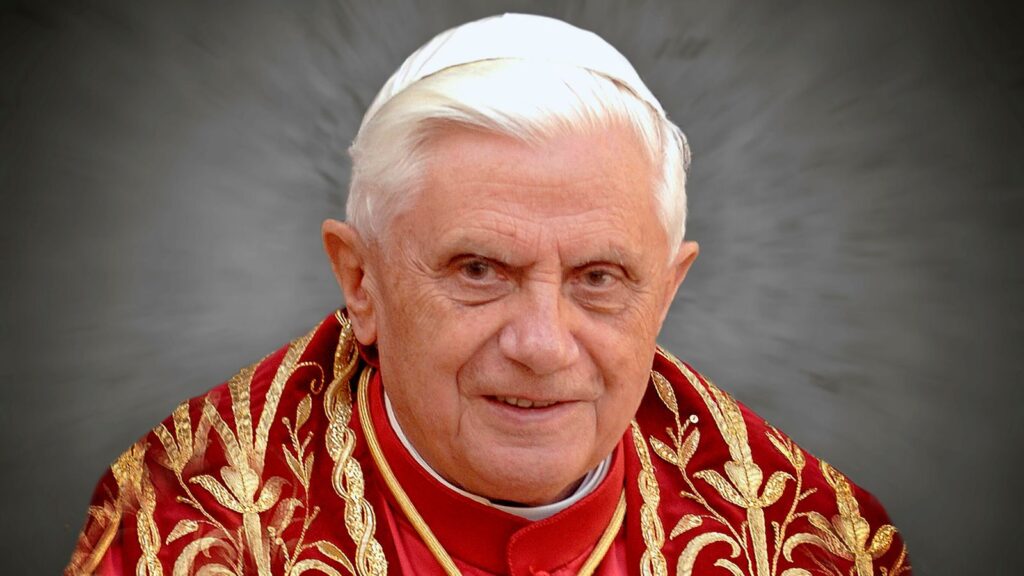
“Pray a special prayer for Pope Emeritus Benedict.” Pope Francis said it at the end of his last general audience of 2022, then left the Vatican’s Paul VI hall and made the short trip to the Mater Ecclesiae monastery, where his predecessor had lived since stepping down. The BBC reported that the Vatican said Benedict’s health had worsened in recent hours. Spokesman Matteo Bruni described the situation as “under control, constantly followed by doctors”. Three days later, on 31 December 2022, Benedict XVI died at 95.
From Bavaria to the papacy
Josef Alois Ratzinger was born on 16 April 1927 in Marktl am Inn, Germany. As a teenager in the Second World War he was made to join the Hitler Youth, then drafted into an anti-aircraft unit and the infantry. In 1945 he deserted and spent time as an American prisoner of war. A year after his release he began studying for the priesthood, was ordained in 1951, and finished a theology doctorate in 1953.
At the University of Bonn he became a theological adviser to Cardinal Joseph Frings of Cologne for the Second Vatican Council, held between 1962 and 1965. Ratzinger argued there for a “new language” in which Catholic theology could speak to a changing world. Decades later, as pope, he rejected readings of the council as a revolution, and he allowed wider use of the old Latin Mass. Francis reversed that decision.
Pope Paul VI named him bishop of Munich and Freising in 1977, and a cardinal soon after. Pope John Paul II later put him in charge of the Congregation for the Doctrine of the Faith, the body that polices Catholic doctrine. He also headed the committee that drafted the Catechism of the Catholic Church, published in 1992. When John Paul II died in 2005, the cardinals elected him pope. He took the name Benedict, after the founder of Western monasticism.
Writings, resignation and the abuse record
As pope he wrote three encyclicals: Deus Caritas Est, on charity as freely given love; Spe Salvi, on hope; and Caritas in Veritate, which ties charity to justice.
In February 2013, at 85, he told the world he would step down. No pope had resigned since Gregory XII in 1415. He cited advanced age, promised to live in seclusion, and became Pope Emeritus. Critics noted that interviews and writings under his name seemed to challenge the reforms of Francis.
The abuse scandal followed him. A German inquiry commissioned by the Church found that, as archbishop of Munich from 1977 to 1982, he failed to act in four cases. The Conversation noted that a January 2022 report criticised his “inaction”. Benedict denied wrongdoing but asked forgiveness for any “grievous fault”.
His voice had weakened in old age. A Maltese cardinal recalled him telling new cardinals that “the Lord has taken away my speech to let me appreciate silence”. Francis said of him: “He speaks softly but follows your conversation.”
Sources
- Pope Benedict XVI: A man at odds with the modern world who leaves a legacy of intellectual brilliance and controversy (The Conversation)
- Pope Francis appeals for prayers for 'very ill' predecessor Benedict (BBC News)