At 3.38pm on 2 March 1969, Concorde 001 lifted off from Toulouse while 600 journalists watched. The flight lasted 29 minutes and stayed under 480 kph. Captain André Turcat, who flew it, called it “a trip around the runway.” Modest as it was, it put two nations’ seven years of work into the air.
A treaty before a plane
Britain and France had decided, in the middle of the Cold War, that a supersonic airliner was too expensive for either to build alone. On 29 November 1962 their agreement committed both to a 50:50 split of research and assembly costs. The name came from the deal itself. Aérospatiale built prototype 001, the British Aircraft Corporation built 002, and the British machine made its own first flight on 9 April 1969, a 22-minute hop between Filton and Fairford.
Concorde 001 first broke the sound barrier in October 1969. It reached Mach 2 on its 102nd test flight. Along the way the teams worked out electronic flight controls, the first cockpit sidestick, anti-skid brakes and a way of shifting fuel in flight to move the centre of gravity. Airbus later said the lessons helped it avoid pitfalls when it was created.
The aircraft
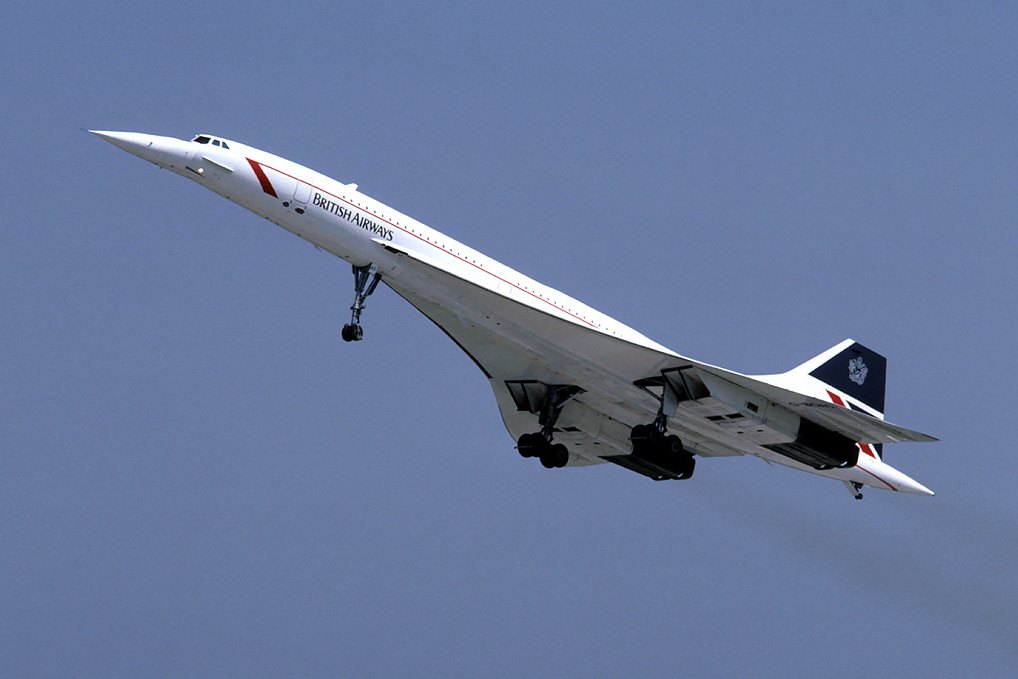
It looked like nothing else: a slim, tailless fuselage, an ogival delta wing and a nose that drooped for landing. Rolls-Royce Olympus engines, each delivering 38,000 pounds of thrust, pushed it to a maximum of 1,330 mph, and it could hold supersonic speed without afterburners. It cruised between 55,000 and 60,000 feet. Inside, 92 to 128 passengers sat four across.
The Soviet Tu-144 had flown first, in 1968, and was faster at Mach 2.15 against Concorde’s Mach 2.04. It was also inefficient and costly, needed afterburners throughout, and flew a single route from Moscow to Almaty.
Seven more years, then the decline
Concorde entered service with Air France and British Airways in 1976. A round trip cost $12,000, and the tagline promised passengers could “Arrive Before You Leave.” Most flights ran New York to London or New York to Paris. Crossing the Atlantic took half the roughly seven hours of an ordinary jet.
Few airlines wanted it. The Smithsonian’s National Air and Space Museum counts 20 built, while Airbus puts the number at 16; either way only Air France and British Airways flew it, and both were state-run at the time. The sonic boom kept it over water. A regular flight burned 6,771 gallons of fuel.
The crash at Gonesse near Paris in 2000, the type’s only one, did lasting damage to its reputation. The fall in travel after 9/11 finished the job, and the last commercial flight came on 24 October 2003. One airframe now sits at the Steven F. Udvar-Hazy Center in Chantilly, Virginia.
Sources
- What Happened to the Concordes? | National Air and Space Museum
- The day Concorde flew into the history books | Airbus