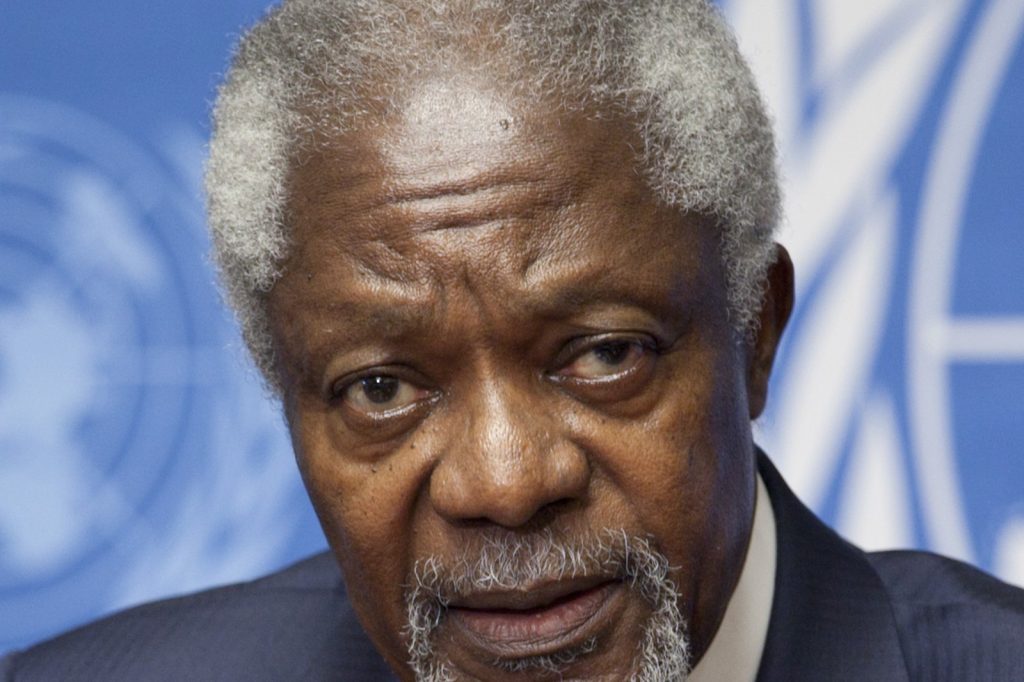
Kofi Annan once told Saga magazine that he had expected to go into Ghanaian politics, retire to a farm at 60 and die in his bed at 80. “It did not happen so,” he said. “It’s one of the things God does.” He did die at 80, in a hospital in Bern, Switzerland, on August 18, 2018, after a short illness. Almost everything in between went differently from the plan.
A Ghana coming of age
Annan was born in Kumasi on April 8, 1938, minutes ahead of his twin sister, Efua Atta. He was the grandchild and nephew of three tribal chiefs, which placed him in one of Ghana’s aristocratic families. In his mid-teens he went to Mfantsipim, an elite Methodist boarding school, where he picked up the idea that “suffering anywhere concerns people everywhere.”
He graduated in 1957, the year Ghana became the first British African colony to win independence. “People of my generation, having seen the changes that took place in Ghana, grew up thinking all was possible,” he told The New York Times.
His studies ran through four institutions: the Kumasi University of Science and Technology, Macalester College in St. Paul, Minnesota, the graduate institute in Geneva, and MIT, where he was a Sloan Fellow in 1971-1972 and took a Master of Science in management. He spoke English, French and several African languages.
Climbing the UN ladder
In 1962 he joined the World Health Organization in Geneva as an administrative and budget officer. Postings followed with the UN Economic Commission for Africa in Addis Ababa, the emergency force in Ismailia and the refugee agency in Geneva, before New York. He broke off for only two years, 1974 to 1976, to run tourism in Ghana.
When Iraq invaded Kuwait in 1990, Annan was given a special assignment: bring home more than 900 international staff and secure the release of Western hostages. He later led the first UN team to negotiate with Iraq over selling oil to pay for humanitarian aid.
His peacekeeping years coincided with a huge expansion of missions, peaking in 1995 at almost 70,000 military and civilian personnel from 77 countries. They also included the Rwandan genocide. Roméo Dallaire, the force commander in Rwanda, accused Annan of being too passive. Roughly a decade later, Annan admitted that he “could and should have done more to sound the alarm and rally support.”
Secretary-General
The Security Council recommended him in late 1996 to succeed Boutros Boutros-Ghali of Egypt, and the General Assembly voted in his favor. He started on January 1, 1997, as the first Secretary-General elected from the ranks of UN staff. His opening move was a reform plan, “Renewing the United Nations,” presented to member states in July 1997.
He pushed the “Global Compact” with the business world, issued a five-point Call to Action on HIV/AIDS in April 2001 and proposed a Global AIDS and Health Fund. In December 2001 he and the UN shared the Nobel Peace Prize “for their work for a better organized and more peaceful world.” He also called the 2003 invasion of Iraq illegal, telling the BBC in September 2004 that it did not conform to the UN charter.
After the UN
Annan retired on December 31, 2006. His farewell speech warned of an unjust world economy and widespread contempt for human rights. “Global solidarity is both necessary and possible,” he said. He went back to Ghana, helped lead the Alliance for a Green Revolution in Africa, joined the Global Elders and took the presidency of the Global Humanitarian Forum in Geneva.
In February 2012 he became the UN and Arab League envoy to Syria and drew up a six-point peace plan. On August 2, 2012, he resigned. “As an envoy, I can’t want peace more than the protagonists, more than the Security Council or the international community, for that matter,” he said.
His wife Nane and their children Ama, Kojo and Nina were with him when he died. The Kofi Annan Foundation and his family called him “a global statesman and a deeply committed internationalist who fought throughout his life for a fairer and more peaceful world.”