
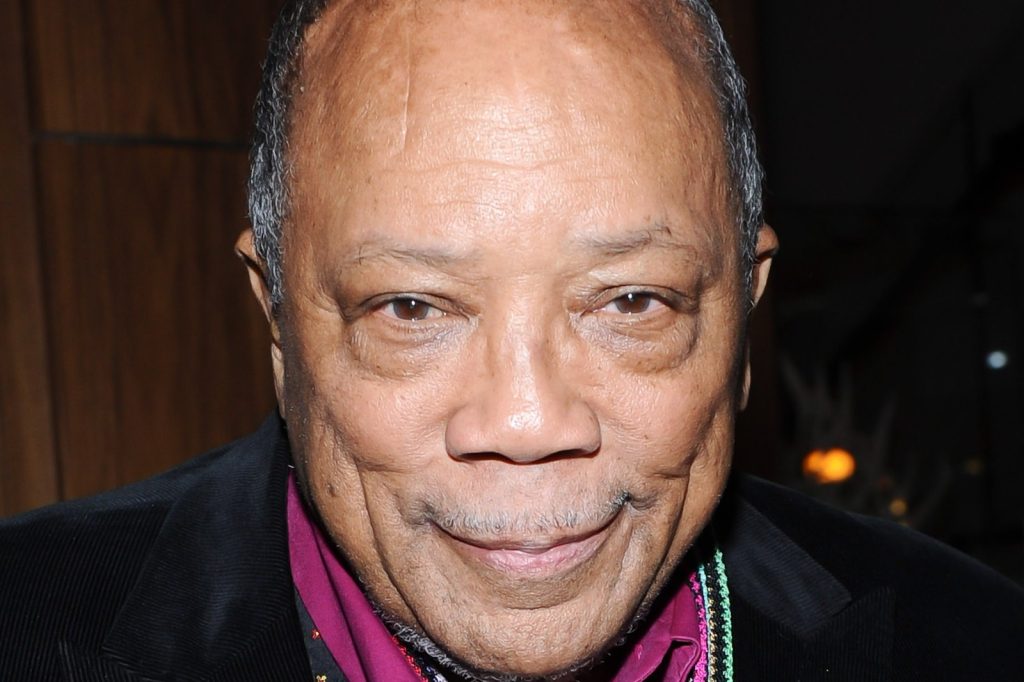
Early Life
Quincy Delight Jones Jr. was born on March 14, 1933, in Chicago, Illinois, U.S. After World War II, he moved with his family to Seattle, where he attended Seattle University. He later pursued his musical education at what is now the Berklee College of Music in Boston. These formative years laid the foundation for his deep engagement with jazz, arranging, and composition.
His early exposure to music in Seattle and Boston allowed him to develop skills as a trumpet player and keyboardist, which would become central to his identity as a musician. The environment of postwar American music, particularly the vibrant jazz scenes he encountered, nurtured his artistic growth.
Jones began his professional journey in the 1950s, emerging as a jazz arranger and conductor. This period marked the start of a career that would span over seven decades, rooted in the traditions of big band and jazz while gradually expanding into broader musical territories.
Rise
Jones came to prominence in the 1950s as a jazz arranger and conductor, establishing himself within the upper echelons of American jazz circles. His work during this time involved crafting intricate arrangements and leading ensembles with precision and creativity, earning respect among peers and bandleaders alike.
In the early 1960s, he transitioned into producing pop hit records, most notably for Lesley Gore, including the iconic song “It’s My Party.” This shift demonstrated his versatility and ability to bridge genres, bringing jazz sensibilities to mainstream pop production.
Simultaneously, Jones served as an arranger and conductor for several high-profile collaborations between Frank Sinatra and Count Basie. These projects placed him at the intersection of legendary vocal talent and big band innovation, further solidifying his reputation as a masterful musical architect.
Peak
Jones reached a creative zenith through his production of three landmark albums by Michael Jackson: _Off the Wall_ (1979), _Thriller_ (1982), and _Bad_ (1987). These records not only defined the sound of their era but also achieved unprecedented commercial and critical success, with _Thriller_ becoming one of the best-selling albums of all time.
In 1985, he produced and conducted the charity single “We Are the World,” a global effort to raise funds for victims of the famine in Ethiopia. The song brought together dozens of major artists and became a cultural touchstone, showcasing Jones’s ability to mobilize music for humanitarian causes.
Throughout this period, Jones also composed numerous film scores, including for _The Pawnbroker_ (1965), _In the Heat of the Night_ (1967), _In Cold Blood_ (1967), _The Italian Job_ (1969), _The Wiz_ (1978), and _The Color Purple_ (1985). His work in film scoring highlighted his narrative sensitivity and orchestral mastery, earning him multiple Academy Award nominations.
Turning Point
Jones’s career evolved beyond production and composition into broader recognition of his artistic and humanitarian contributions. In 1977, he won the Primetime Emmy Award for Outstanding Music Composition for a Series for his work on the miniseries _Roots_, affirming his impact in television music.
His achievements continued to be honored across decades: he received the Grammy Legend Award in 1992, the Jean Hersholt Humanitarian Award in 1995, and the Kennedy Center Honors in 2001. These accolades reflected not only his musical excellence but also his commitment to social causes and cultural enrichment.
In 2011, Jones was awarded the National Medal of the Arts, one of the highest honors bestowed by the United States government for artistic achievement. Two years later, in 2014, he received the Ordre des Arts et des Lettres from France, recognizing his international influence on music and culture.
Legacy/Aftermath
Quincy Jones remained active in music until his death on November 3, 2024, in Los Angeles, California, U.S., at the age of 91. His career spanned from 1951 to 2024, marking over seven decades of continuous creative contribution. He was laid to rest at Hillside Memorial Park Cemetery.
Among his final honors, Jones served as a producer for the 2016 Broadway revival of _The Color Purple_ (musical), for which he received a Tony Award for Best Revival of a Musical. This late-career achievement underscored his enduring relevance and ability to shape theatrical music across generations.
His legacy is defined by an extraordinary breadth of work: as a trumpeter, keyboardist, composer, arranger, conductor, and producer, Jones influenced jazz, pop, soul, R&B, film, television, and theater. He received 28 Grammy Awards, a Primetime Emmy, a Tony Award, and nominations for seven Academy Awards and four Golden Globe Awards—testaments to a career of rare versatility and sustained excellence.
Wider Significance
Jones’s impact extends beyond individual awards or hit records. He helped redefine the role of the producer as a visionary auteur, blending technical mastery with artistic direction in ways that inspired generations of musicians and creators. His collaborations across racial, genre, and generational lines modeled a vision of music as a unifying force.
Through projects like “We Are the World,” he demonstrated how popular music could be harnessed for global humanitarian efforts, setting a precedent for artist-led activism. His film and television scores brought emotional depth to stories about American life, history, and struggle, enriching the cultural landscape.
Ultimately, Quincy Jones’s life stands as a testament to the power of persistence, curiosity, and artistic integrity. From the jazz clubs of Seattle to the global stage, he shaped the sound of the second half of the twentieth century and beyond, leaving behind a body of work that continues to resonate across music, media, and society.
Sources
https://en.wikipedia.org/wiki/Quincy_Jones | https://www.complex.com/tag/quincy-jones




