The story begins with a young officer from a family that lived and breathed politics. Ollanta Humala was born in Lima on 27 June 1962, the son of Isaac Humala, a Quechua labor lawyer, Communist Party member and ideological leader of the ethnocacerista movement, and Elena Tasso, whose Italian family had settled in Peru in the late 19th century. His brother Antauro would later serve 25 years in prison for kidnapping 17 police officers and killing four of them in the Andahuaylas uprising.
A soldier’s rebellion
Humala joined the army in 1981 and rose to lieutenant colonel. He fought the Shining Path insurgency and served in the 1995 Cenepa War with Ecuador. In October 2000, in the last days of Alberto Fujimori’s regime, he led an uprising at Toquepala. The stated trigger was the capture of Vladimiro Montesinos, Fujimori’s former intelligence chief, who had fled after being filmed trying to bribe an opposition congressman. Humala and about 40 soldiers revolted. Many deserted, leaving him with seven men. The newspaper La República called him “valiant and decisive, unlike most in Peru.” Fujimori was removed a few days later, and on 10 December the brothers surrendered. On 21 December 2000 Congress granted them amnesty, and Humala returned to duty.
Peru sent him abroad afterward, first as military attaché in Paris and then in Seoul, until he was forcibly retired in December 2004.
The road to the presidency
In 2005 he founded the Peruvian Nationalist Party. He won the first round of the 2006 election with 30.62 percent but lost the runoff to Alan García. His campaign drew global attention as the “pink tide” swept Latin America. In 2011 he ran again and defeated Keiko Fujimori in the runoff. To calm fears of radical policies, he filled much of his cabinet with centrists. He had begun as a leftist and moved toward neoliberalism and the political center in office. His presidency proved unpopular, and corruption allegations involving him and his wife, Nadine Heredia, hung over his 2011 to 2016 term. Environmentalists said he reneged on a promise to rein in mining companies.
Arrest and conviction
Authorities arrested Humala in 2017 on corruption charges. He tried a comeback in the 2021 presidential election and won 1.5 percent, finishing 13th. In 2025 he and Heredia were convicted of money laundering tied to the Brazilian construction company Odebrecht, and each received 15 years. Brazil granted Heredia diplomatic asylum, and she remains there.
As of 2026, Humala was the last Peruvian president to serve a full term. Most of his successors have resigned or been impeached.
Sources
- Ollanta Humala
- Cross-border endorsements and the US Congress – October 2026
- The Worldfolio: Blanca Magali Silva Velarde-Álvarez – The Worldfolio News
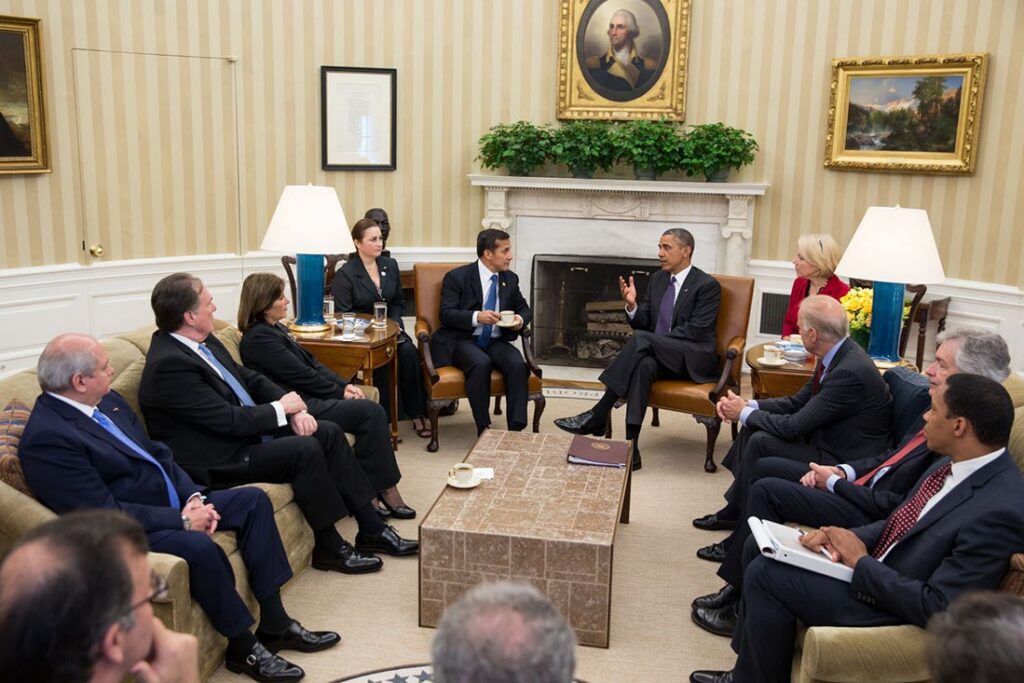
Photo: Pete Souza (Public domain)