
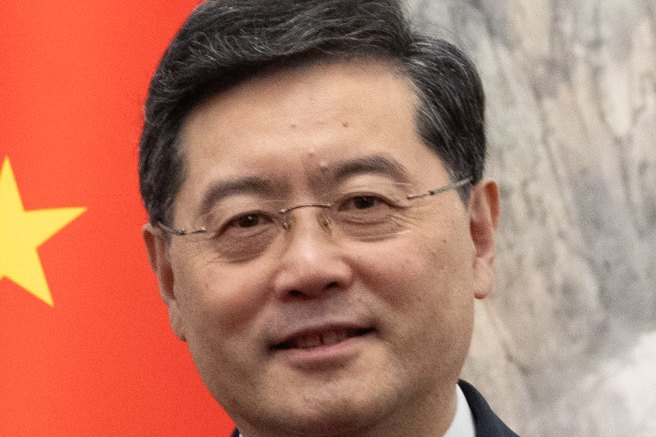
In June 2023 the public profile of China’s foreign minister, Qin Gang, disappeared without explanation, and weeks later he was formally removed from his post. The episode offers a window into a political system where senior officials can be erased quickly and without public justification.
Qin Gang’s diplomatic career followed a classic upward trajectory. Born in Tianjin and raised in Hebei, he entered the International Relations Academy in 1984 and graduated in 1988. His first assignment was as a Chinese secretary at the Beijing Foreign Affairs Service Bureau, and by 1992 he had joined the Ministry of Foreign Affairs.
He later served as a secretary at the Chinese embassy in the United Kingdom and headed the ministry’s Information Department. In 2010 he was appointed minister at the Chinese embassy in London, after which he returned to Beijing to become the ministry’s spokesperson.
The pinnacle of his service came in 2021, when he was named ambassador to the United States. After a brief tenure in Washington, he was recalled in January 2023 and elevated to foreign minister, a role that placed him at the forefront of China’s external communications. However, his time in that position lasted only a few months.
By June 2023 Qin Gang stopped appearing at scheduled diplomatic events and vanished from the public eye. Chinese‑language media and the Chinese version of Wikipedia noted his disappearance and later reported his dismissal, but no official reason was provided.
The silence surrounding the episode has generated speculation, yet the state’s lack of comment leaves the matter largely unexplained. The significance of Qin’s removal extends beyond one individual’s career. As a fluent English speaker comfortable with Western media and Washington circles, Qin represented a visible, outward‑facing facet of Beijing’s diplomacy.
His sudden absence suggests that such visibility can become a liability within a system that prioritizes internal conformity over external engagement. In China, personnel decisions at the highest levels are made behind closed doors by the Communist Party, which retains ultimate authority over appointments.
When a figure of Qin’s stature is withdrawn without public acknowledgment, the message sent to other officials is unmistakable: loyalty and performance are judged by criteria that are not disclosed, and missteps can lead to swift, total removal. The Ministry of Foreign Affairs now operates without a publicly named head, forcing other diplomats to adjust their conduct. The disappearance of a known interlocutor removes a familiar channel for foreign governments, particularly Washington, and introduces uncertainty for the successor who must navigate a more constrained diplomatic environment.
Analysts note that the episode does not fit the pattern of a Western‑style scandal—there are no leaked documents, investigative hearings, or public accusations. Instead, the void left by Qin’s erasure serves as a cautionary example within the party hierarchy, reinforcing a culture where silence is rewarded and prominence can be punished.
Qin Gang’s service spanned from his first posting in 1988 to his brief stint as foreign minister in 2023. His rapid rise and equally swift fall illustrate how the same structures that elevate officials can also consume them when internal judgments deem it necessary. The episode underscores a broader trend toward tighter control over China’s diplomatic corps, with potential implications for the stability and openness of its foreign policy.




