Anthony Quainton, the US ambassador in Bangui, was kept waiting for hours to hand over his gift. He was low on the protocol list, and ministers went in first. The present, two silver Franklin Mint plates, bore the portraits of Chester Arthur and Millard Fillmore, because the more famous presidents were sold out. Bokassa received them with “enormous pleasure, real or feigned” and promised them a place in an imperial museum that was never built.
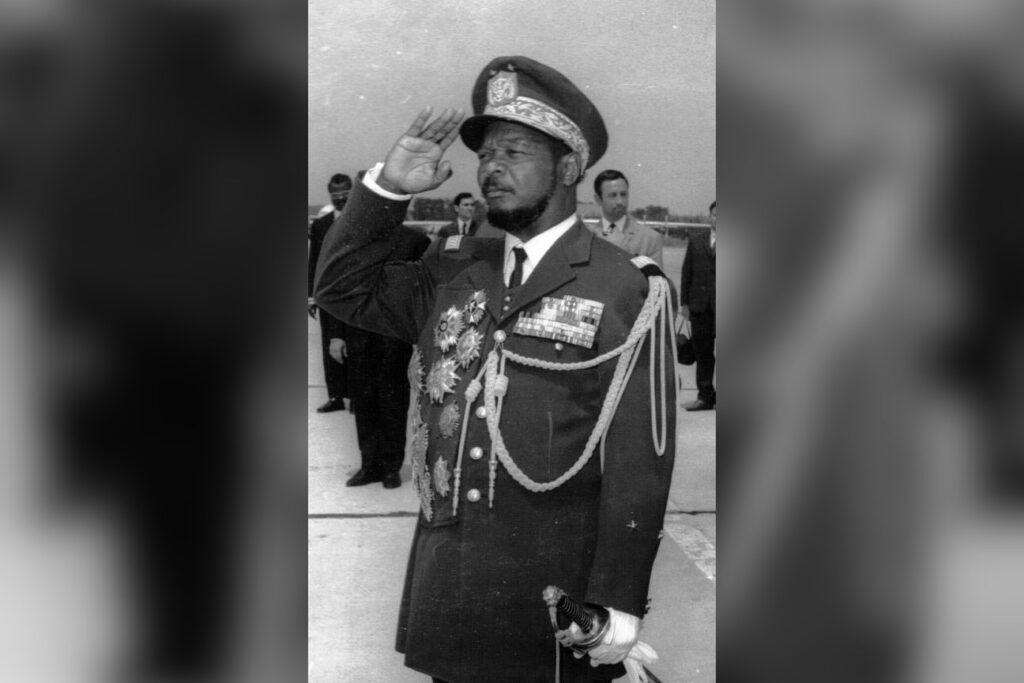
That small scene says a lot about the coronation of Jean-Bedel Bokassa, the army man who ruled the Central African Republic from 1966 to 1979 and then made himself emperor.
A soldier of France
Bokassa served in the French Colonial Army in his youth and reached the rank of captain, fighting in what became Vietnam. He took power in a military coup, and his rule turned erratic and often brutal. Paris still saw little alternative to him. He had a claim to French nationality through his army service, publicly admired Charles de Gaulle, kept a chateau in Sologne, and went elephant hunting every year with French president Giscard d’Estaing. Quainton recalled the two men spending two weeks on safari trading war stories. Bokassa also gave Giscard a diamond necklace, which later grew into a scandal in France.
Why an empire
By early 1978, Quainton said, Bokassa decided that the titles of seven-star field marshal and president for life did not win him enough respect in post-colonial Africa. The first hint came when his wife gave birth to a daughter, Anne, and the local press called her Princess Anne. Rumours spread about what kind of empire was coming. Most people guessed he would copy a medieval African one. Instead he announced that he had traced his ancestry to the pharaohs, while modelling the style on Napoleon. In practice, said Quainton, “it was a black version of Napoleon’s empire.”
It was an expensive idea. The French disapproved of the Napoleonic ambitions but did not insist on an African-style kingship, and in the end agreed to pay the full cost. Some accounts put it at $45 to 50 million. Quainton described it as roughly a year’s budget for the entire country.
Court protocol and a coronation
Bokassa invited the Pope to crown him, as Napoleon had. When he got no pope, he asked ambassadors for advice. The American was not consulted, since the US was not thought to have wisdom on imperial practice. He asked the Greek ambassador in Yaounde about the court of Constantine Palaeologus, the last Byzantine emperor.
Diplomats then received a note on how to behave before His Imperial Majesty: how far to stand, how to bow, how to answer. The answer to any question was always “Yes”, though “Yes, but” was allowed if that left something to be desired. Visitors were meant to retreat backwards. This was announced but never enforced. Quainton thought Bokassa enjoyed writing it all up as a joke.
France sent its aid minister, Mr. Gallet, and his wife. Most governments sent resident ambassadors, and President Mobutu came up from Zaire, if Quainton remembered correctly. The ceremony took place in a basketball stadium built by Yugoslavia as aid, seating several thousand, with a golden throne shaped like an imperial eagle. Bokassa wore a Roman toga embroidered with a hundred thousand pearls and a gold laurel wreath. As Napoleon had, he crowned himself. A coach drawn by six white horses flown in from Paris carried him to the cathedral, which was decked floor to ceiling with tens of thousands of cut flowers from France.
The cathedral setting had its own irony. Bokassa was no longer a Catholic. He had become a Muslim some months before, during a visit by Muammar Gaddafi.
The fall
Washington thought the whole affair foolish, Quainton said, but moved cautiously, because the US needed Bokassa’s votes at the United Nations and worried about its missionaries and business people on the ground. He deliberately wrote his cables with a straight face.
Patience in Paris ran out in 1979. French paratroopers overthrew Bokassa, but only after he personally directed the shooting of high school students in the centre of Bangui.