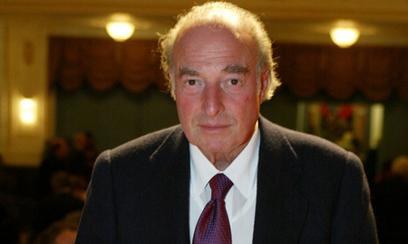
“I deliver a service,” Marc Rich liked to say. “People want to sell oil to me and other people wanted to buy oil from me. I am a businessman, not a politician.” The Swiss journalist Daniel Ammann, who wrote his biography, remembered the line well. It also describes, in two sentences, how a boy who fled the Nazis ended up on the FBI’s most-wanted list and then on Bill Clinton’s last-day pardon list.
From Antwerp to the Philipp Brothers mail room
Rich was born in Antwerp in 1934 to a Jewish family. In 1941 his parents took him to the United States, travelling through Vichy France, Spain and Portugal and sailing on the liner Serpa Pinto. The family later settled in Queens, where his father ran an import business. Rich went to New York University but dropped out after one semester. In 1954 he started at the commodities house Philipp Brothers, working his way up from the mail room to become a metals dealer. He learned the raw-materials trade there, and learned how to do business with poor countries and awkward regimes.
In 1974 he and colleague Pincus Green set up their own firm in Switzerland, Marc Rich + Co. AG. It later became part of Glencore.
The King of Oil
Rich’s partners called him “the King of Oil”. He is credited with building the spot market for crude, selling cargoes at the day’s price instead of tying buyers to long-term contracts, and in doing so he pulled business away from the big oil groups. Andrew Hill of the Financial Times wrote that Rich’s insight was that oil could be traded with less capital and fewer assets than the producers assumed, if bank finance stood behind it. That leveraged model, Hill said, became the template for Trafigura, Vitol and Glencore. For Asian buyers and refiners, who today lean heavily on spot cargoes and trading houses, the legacy is not abstract.
He went where others would not. Ammann put it bluntly to the Guardian: Rich “became rich because he was able to profit from boycotts.” His clients included apartheid South Africa, Fidel Castro’s Cuba, Gaddafi’s Libya, Ceausescu’s Romania and Pinochet’s Chile. After the 1979 revolution in Iran he used his contacts to keep buying Iranian crude despite the American embargo, and Iran became his most important supplier for more than 15 years. Some of that oil went on to Israel. Ammann said Israel, cut off from supply after the Yom Kippur war, bought from Rich when few others would sell.
The indictment
In 1983 Rich and Green were indicted on 65 counts, among them income tax evasion, wire fraud, racketeering and trading with Iran while Iranian revolutionaries still held American hostages. Rudolph Giuliani, then the federal prosecutor in New York, called it the biggest tax evasion case in American history. A conviction on every count could have meant more than 300 years in prison.
Rich heard about the plans for the indictment and left for Switzerland. He always insisted he was innocent, arguing that the Iranian trades were legal because they ran through a Swiss company. He never came back. His companies eventually pleaded guilty to 35 counts of tax evasion and paid $90 million in fines, but Rich himself stayed on the FBI’s ten most-wanted list for years. He came close to arrest in airports in Switzerland and Finland, according to Ammann. In 1996 he did not return for his daughter’s funeral, for fear of being picked up.
Meanwhile he sold his stake in the firm in 1993, when the renamed Glencore was doing $30 billion of business a year in 125 countries. A year earlier he had paid his ex-wife $365 million in a record divorce settlement.
The pardon
On January 20, 2001, hours before leaving office, Clinton pardoned him. The reaction was fierce. Denise Rich, Marc’s former wife, had given $450,000 to the Clinton library foundation and more than $1 million to Democratic causes, including Hillary Clinton’s Senate campaign. Jimmy Carter, a fellow Democrat, said there was no doubt the large gifts were a factor and called it “disgraceful”.
Clinton pointed elsewhere. Israeli leaders including Ehud Barak and Shimon Peres had lobbied him, and he told The New York Times that officials of both major Israeli parties and Jewish community leaders in America and Europe had urged the pardon. Rich himself had told Ammann, reluctantly, that he had helped the Mossad. Clinton later admitted: “It wasn’t worth the damage to my reputation.”
Mary Jo White, and after her James Comey, investigated the pardon under Attorney General John Ashcroft, and Congress held its own hearings. Clinton’s senior advisers testified that nearly all the White House staff who weighed in had urged him against it. Investigators found no evidence of criminal activity.
Death
Even with the pardon, Rich stayed away from the United States, fearing officials would find another charge. He died in Switzerland on June 26, 2013, aged 78. Newsday, citing his spokesman, reported a stroke in hospital; the Guardian reported a heart attack at his home in Lucerne. He was to be buried in Israel. Glencore’s chief executive Ivan Glasenberg called him “one of the great pioneers of the commodities trading industry.”
Sources
- Marc Rich – Wikipedia
- Marc Rich: controversial commodities trader and former fugitive dies aged 78
- Marc Rich, controversial oil trader, dead at 78 – Newsday