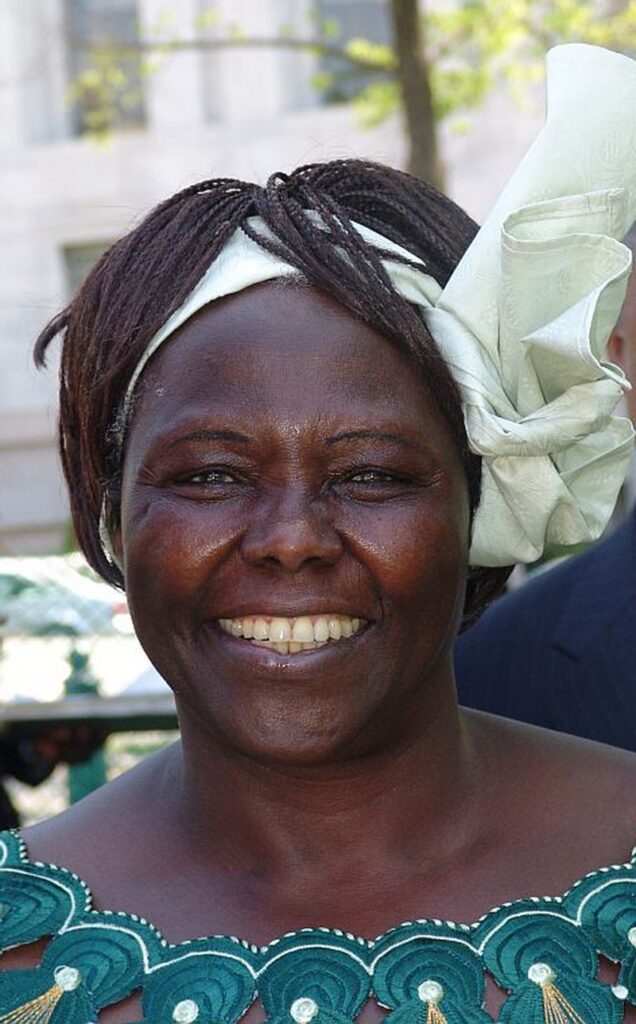
Wangari Muta Maathai, the Nobel Peace Prize-winning environmentalist who founded the Green Belt Movement, died at Nairobi Hospital at 71 after what her website called “a prolonged and bravely borne struggle with cancer.” National Geographic’s remembrance described a life of firsts.
Early life and education
Maathai was born on April 1, 1940, in the village of Ihithe, near Nyeri, in Kenya’s central highlands. Most Kenyan girls then went without schooling, but she went to school at the urging of her elder brother, Nderitu. Catholic missionary nuns taught her, and she graduated from Loreto Girls’ High School in 1959.
The next year she was part of the “Kennedy airlift,” a scholarship program run by the U.S. government and the Kennedy family. It took her to Mount St. Scholastica, now Benedictine College, in Atchison, Kansas, where she earned a bachelor’s degree in biological sciences. She completed a master’s at the University of Pittsburgh in 1966 and went home to a newly independent Kenya. She joined the University of Nairobi’s School of Veterinary Medicine and earned a Ph.D. in 1971, the first woman in east and central Africa to do so. She also became the first woman to chair a department there and the first appointed professor.
The Green Belt Movement
In the 1970s Maathai became active in environmental and humanitarian groups in Nairobi, including the National Council of Women of Kenya. Rural women told her they lacked firewood, clean water and nutritious food. She suggested planting trees. Trees would supply wood for cooking, fodder for livestock and fencing, protect watersheds and steady the soil. The Green Belt Movement was formally established in 1977, and it has since mobilized hundreds of thousands of women and men to plant more than 47 million trees.
As the work grew, she saw that poverty and environmental damage were tied to disempowerment and bad governance. Tree planting became a way into a larger social and political agenda. “You cannot protect the environment unless you empower people,” she said.
Confronting the Moi regime
In the 1980s and 1990s the movement joined pro-democracy advocates against the dictatorial government of President Daniel arap Moi. Maathai’s campaigns halted a skyscraper planned for Uhuru Park in downtown Nairobi and stopped the grabbing of public land in Karura Forest. She also helped lead a yearlong vigil with mothers of political prisoners that won freedom for 51 men. For this, she and her colleagues were repeatedly beaten, jailed, harassed and publicly vilified.
Office and honors
In December 2002, in the first free and fair elections in a generation, she was elected Member of Parliament for Tetu, near where she grew up. In 2003 President Mwai Kibaki appointed her Deputy Minister for the Environment. After the violence that followed the contested 2007 elections she served as a mediator, and she and the movement helped ensure Kenya’s new constitution, ratified in 2010, guaranteed a clean and healthy environment.
In 2004 she received the Nobel Peace Prize, the first African woman and the first environmentalist to do so. The Norwegian Nobel Committee praised her “holistic approach.” Earlier honors included the Goldman Prize in 1991 and the Right Livelihood Award in 1984. France gave her the Legion d’Honneur in 2006 and Japan the Order of the Rising Sun in 2009. In 2006 she co-founded the Nobel Women’s Initiative with five other female peace laureates, and she joined the United Nations Environment Programme in a campaign to plant a billion trees, a goal met in under a year. In 2009 she was named a UN messenger of peace.
She wrote four books, including her autobiography, Unbowed (2006). She was survived by her children Waweru, Wanjira and Muta, and her granddaughter, Ruth Wangari.