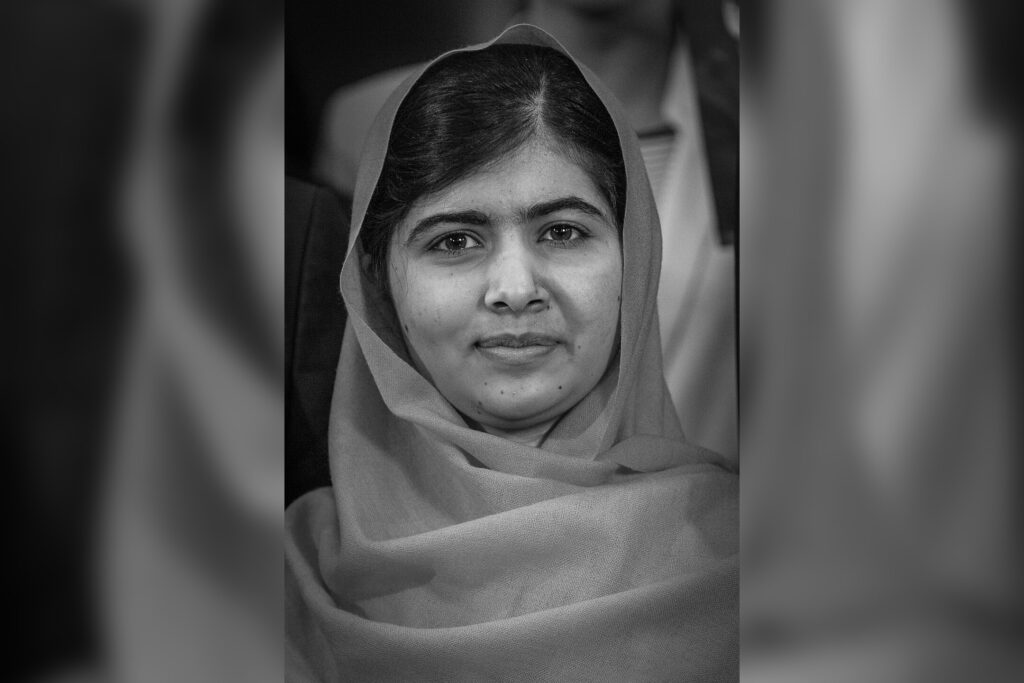
“Who is Malala?” The question came from a masked gunman who boarded a school bus in the Swat Valley in October 2012. It was the start of a very different life for a 15-year-old girl who had only wanted to go to class.
A school, a father and a banned classroom
Malala Yousafzai was born on July 12, 1997, in Mingora, the largest city in the Swat Valley, in what is now Pakistan’s Khyber Pakhtunkhwa Province. Her father, Ziauddin, ran a school and was set on giving his daughter every chance a boy would get. By her own account, she toddled into lessons before she could talk and played at being the teacher.
In 2007 the Taliban began to take control of the valley. Girls were banned from school, and so were dancing and television. By the end of 2008, the Nobel Foundation’s biography says, the Taliban had destroyed some 400 schools. In January 2009 Malala, then 11, said goodbye to her classmates not knowing if she would return.
She did not stay quiet. “How dare the Taliban take away my basic right to education?” she asked on Pakistani TV. Early in 2009 she began blogging for the BBC’s Urdu site under the name “Gul Makai,” writing about life under Taliban rule. Her first entry, headed “I am afraid,” described her nightmares about going to school. On May 5, 2009, she became an internally displaced person when war forced her family to flee.
Recognition and a target
Her voice carried. In 2011 Archbishop Desmond Tutu nominated her for the International Children’s Peace Prize, and Pakistan awarded her its National Youth Peace Prize. Not everyone welcomed it.
On the morning of October 9, 2012, two Taliban members stopped her school bus. One asked for her by name and fired three shots. A bullet entered and exited her head and lodged in her shoulder. She was airlifted to a military hospital in Peshawar, and four days later to intensive care in Birmingham, England. She woke from a medically induced coma, needed multiple surgeries, including a repair of a facial nerve, and suffered no major brain damage. By March 2013 she was back in school in Birmingham.
From survivor to laureate
On her 16th birthday, July 12, 2013, Malala spoke at the United Nations in New York, urging access to education for all children. The U.N. later recognised July 12 as Malala Day. That year she published the autobiography “I Am Malala,” and on October 10, 2013, the European Parliament gave her the Sakharov Prize for Freedom of Thought. With her father she set up Malala Fund.
In 2014 she traveled to Jordan to meet Syrian refugees, to Kenya to meet students, and to northern Nigeria for her 17th birthday, where she backed the girls abducted by Boko Haram. That October she shared the Nobel Peace Prize with Indian children’s rights activist Kailash Satyarthi. At 17 she was the youngest person ever to receive it. “This award is not just for me,” she said. “It is for those forgotten children who want education.”
Oxford and afterward
In 2017 she began studying Philosophy, Politics and Economics at Oxford, and she graduated from Lady Margaret Hall in 2020, finishing her last months in her parents’ house during the pandemic. She married Asser Malik in 2021.
In 2024 Malala Fund turned 10, and she marked it with a speech at U.N. House in Nigeria. She has also spoken out for Afghan girls banned by the Taliban from secondary school, carrying their stories to Johannesburg, New York City and Islamabad. As of 2025 she is executive chair and co-founder of the fund, and works on film production and writing as well. The fund says 122 million girls are out of school.