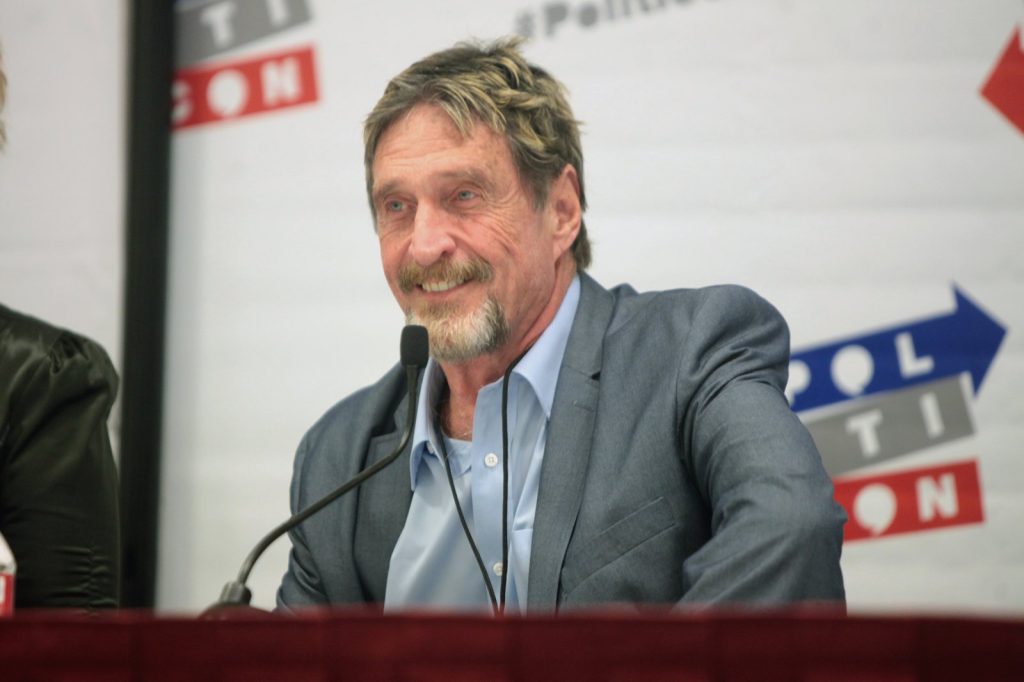
John McAfee’s fortune in anti-virus software was reported at around $100 million. By his own account he wrote the original program “in a day and a half,” and 4 million people were using it within a month. What followed over the next two decades was an unusual slide from boardrooms to yoga retreats, ultralight aircraft and, in 2012, a police search in Belize.
From Lockheed to market leader
McAfee was born in England in 1945 and grew up in Virginia, graduating from Roanoke College in 1967 with a bachelor’s degree in mathematics. His early jobs, as programmer, software designer or consultant, took him through Univac, Xerox, Computer Sciences Corporation and Lockheed. At Lockheed he met one of the first computer viruses, the Pakistani Brain, and set about writing software to block it.
He founded McAfee Associates in 1987 and, two years later, left Lockheed to run it full time from Santa Clara, California. His commercial idea was novel: give the software away and charge companies a licensing fee. The BBC said that made him one of a new generation of tech pioneers, and he is credited with pioneering the shareware business. In the 1990s he also helped pioneer instant messaging.
His tenure at the firm was not tidy. In early 1992 he went on US television to warn that a virus called Michelangelo would wreak havoc on PCs worldwide. The software became a market leader almost overnight, but the predicted disaster did not come, and the BBC reported that he was ultimately forced out. Accounts differ on the exit, but he sold his shares in the mid-1990s, reportedly for $100 million. Intel announced in 2010 that it would acquire the company for about $7.68 billion.
Money, planes and Belize
He spent freely. He built nine homes and filled them with art, antique cars and oddities such as a dinosaur skull. He created a yoga retreat in Colorado and a center in New Mexico for aero-trekking, low flights in ultralight aircraft. IBTimes reported that his nephew and another passenger died practicing the sport, and that relatives of the passenger reportedly sued him for $5 million.
In 2009 he told The New York Times that he had lost all but $4 million of his fortune in the financial crisis, and properties and possessions were auctioned. He later said he had not lost it all and had staged the sales to deter lawsuits. “I’ve had 200 lawsuits in my life because my name is John McAfee,” he told ABC News. He then moved to Belize, a former British colony of about 330,000 people.
There he started a company to turn jungle plants into antibiotics. Police raided the lab in May 2012 on suspicion of methamphetamine manufacture. No illegal drugs were found, he was never charged and the lab was shut down. McAfee called the raid retribution for refusing to be extorted.
The Faull case
In November 2012 Gregory Faull, a 52-year-old American living two doors from McAfee’s beachside compound on Ambergris Caye, was found dead, shot in his home. Faull had complained about McAfee’s noisy dogs, armed guards and firearms. Several of the dogs were poisoned shortly before the killing. Belize named McAfee a person of interest, and when police came to his house he was gone. He told Wired he had hidden in a box covered with sand, fearing for his life.
Belize’s prime minister, Dean Barrow, said McAfee seemed “extremely paranoid, even bonkers.” McAfee denied any involvement in Faull’s death. After almost a month on the run he was arrested in Guatemala for entering illegally. As deportation loomed he collapsed, and later admitted he had faked a heart attack. He was never arrested or charged over Faull’s death. A stay of deportation to Belize was won, and Guatemala sent him to Miami instead.
Comeback attempts
A 2016 Showtime documentary, “Gringo,” alleged that McAfee was responsible for Faull’s death. A former caretaker in the film said McAfee paid for a killing, though the man he named as the hit man denied it. Afterward the caretaker and others said they had lied for money. McAfee said the filmmaker paid for false statements. The director, Nanette Burstein, said she did not pay for interviews and that McAfee paid the caretaker to recant.
Back in the US, he settled in Lexington, Tennessee, with his wife Janice, whom he met in Miami. In August 2015 he was stopped on suspicion of drunk driving in Henderson County and pleaded guilty to a DUI, saying he was high on prescribed Xanax. He ran for the Libertarian presidential nomination in 2016 and finished as runner-up to Gary Johnson. He became chief executive of MGT Capital, which invests in cybersecurity, and took paid speaking slots at cybertech conferences.
Sources
- The rise and peculiar fall of software pioneer John McAfee | CBC News
- John McAfee: The Rise and Fall of a Computer Genius
- The rise, and fall, and rise of John McAfee, from tech pioneer to 'person of interest' in a murder case overseas to presidential candidate