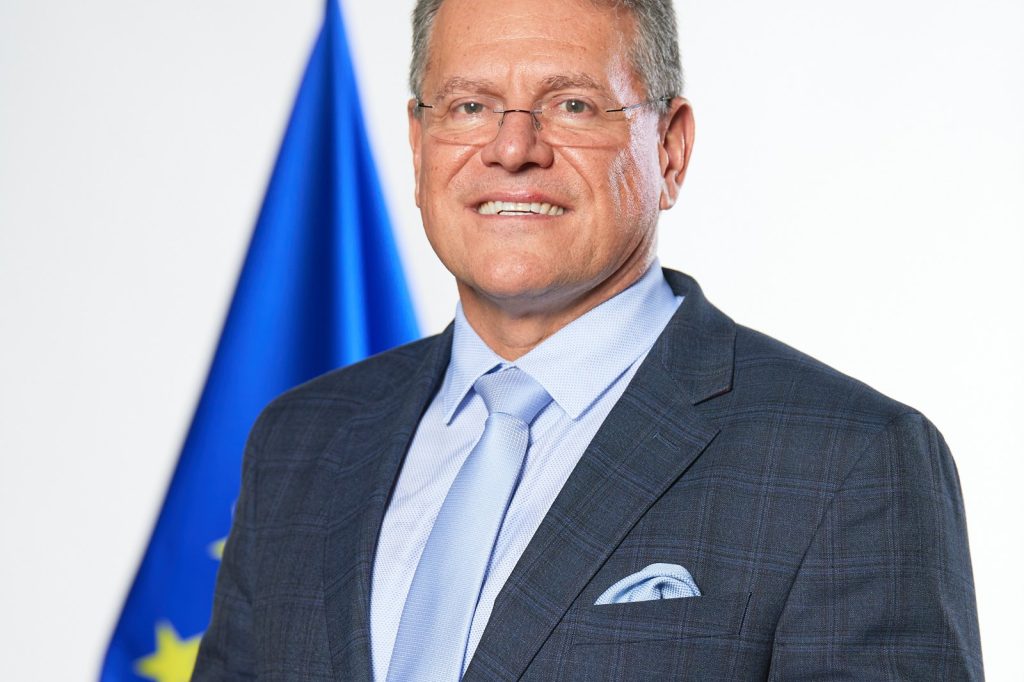
Maroš Šefčovič came back from Beijing with three “shared understandings” and a briefing to give. The EU trade commissioner was due to brief leaders in Brussels ahead of their October 15-16 summit, and he needed their approval. “They would have to see that this is convincing enough to take the other steps,” he said, warning that China could put whole sectors of European industry under threat, “literally thousands of jobs.”
What he brought back is modest. The headline item is a deal on hybrid and plug-in hybrid cars. Šefčovič said it could cut projected Chinese exports of such vehicles to the EU by more than half over four years, which in his words prevents several million cars from arriving. For 2027 alone, that means 500,000 to 700,000 fewer Chinese vehicles. Courthouse News described the arrangement as allowing 350,000 Chinese hybrids into the European market each year for four years.
In return China agreed to ease its hold on rare earths. It also lowered tariffs on EU car parts, olive oil and footwear.
Small against a record deficit
Alicia García-Herrero, a senior fellow at the Brussels think tank Bruegel, saw “negligible progress.” The EU’s goods deficit with China hit €360 billion last year, she noted, while Chinese car exports to the bloc are worth around €15 billion. “A marginal reduction in automotive exports will hardly make a difference,” she said. The tariff cuts save about €225 million in duties, small beside the total. The third understanding, a “green channel” for rare-earth and magnet licences, leaves supply to Beijing’s discretion. “As Washington and Brussels discovered in October 2025,” she said, that guarantees nothing.
The deficit is still widening. In the second quarter of this year it came to €103 billion, against €93 billion in the same quarter of 2025. Courthouse News reported that Chinese imports surged by 25% last year.
The car industry took a kinder view. Sigrid de Vries, director-general of the European carmakers’ association ACEA, said the deal could “help facilitate the transition to a new era of Chinese presence in the European market in an orderly way.” Chinese brands held 14% of the European hybrid market in the first half of 2026, up from 2% in 2024, and 25% of plug-in hybrids, also up from 2%.
What it did to the summit
García-Herrero argued Beijing timed the agreement for exactly this moment. “China’s main interest is preventing the European Council from implementing its trade tools,” she said. If leaders treat the deal as a good start and put off further measures, “this will be China’s most important gain.”
Ahead of the talks, German Chancellor Friedrich Merz and French President Emmanuel Macron wrote to Commission President Ursula von der Leyen about a “massive industrial shock” from Chinese exports. They urged full use of existing trade-defense tools and a new instrument that could allow “an immediate cut-off from the internal market if needed.”
On the first day of the summit, Courthouse News reported, officials looked ready to step back from tough trade measures against Beijing. For the moment, the EU seemed satisfied and had scaled back talk of action that risked a wider trade conflict. The bloc’s 27 leaders also wrestled with fuel prices and the next seven-year budget, and by Thursday evening it looked like they might leave Brussels on Friday without major breakthroughs.
Sources
- EU summit exposes rifts as leaders struggle for breakthroughs on fuel, budget | Courthouse News Service
- EU-China trade deal…more questions than answers