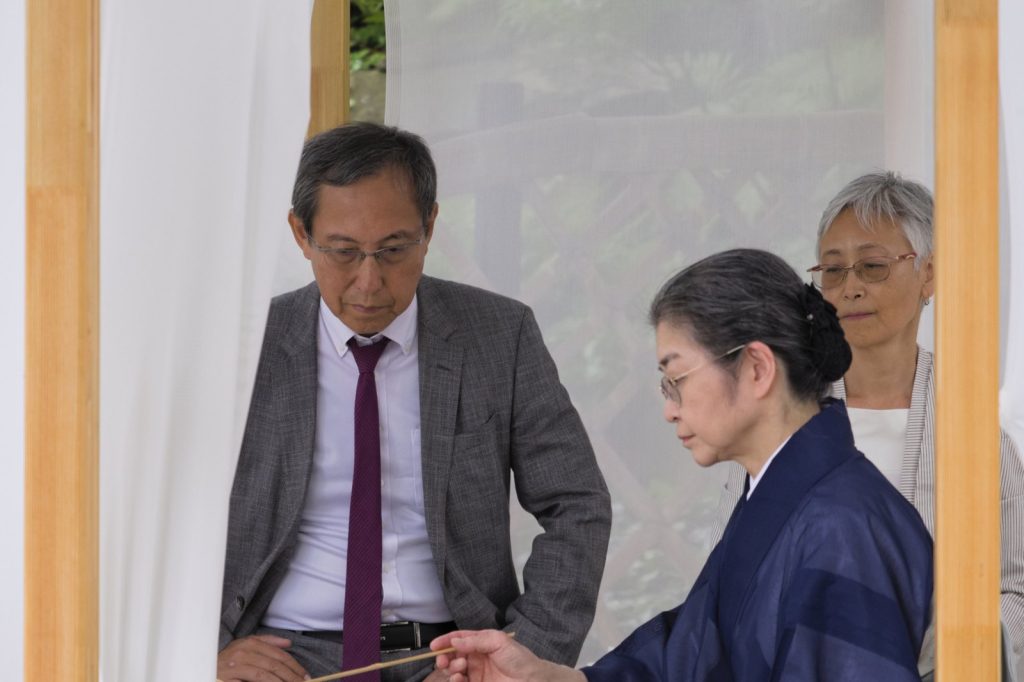
A Japanese tea gathering takes three to four hours. One host, up to five guests, a single bowl of whisked green tea shared in turn. Across the world, in a London hotel, the same hour might hold a tiered stand, a scone and a pot of black tea. Both are rituals built around a pause. They got there by very different roads.
Hot water for tea
Chanoyu, the Japanese tea ceremony, translates literally as “hot water for tea”. Its roots lie in 12th-century Zen Buddhist monasteries in China, where monks treated tea as a rare medicine, offered it at the altar and then drank it together. Japanese monks carried the seeds and the sharing ritual home with the Zen school itself.
For some 400 years tea slowly drifted out of the temples and became a mostly secular pursuit. By the 16th century the military elite who ruled Japan were patrons of a formalised ceremony, and it spread on to merchants and artists. The best-known of those who shaped it was Sen Rikyu, who lived from 1522 to 1591. His descendants have carried the tradition on for 16 generations, and one of them, Sen Soshitsu XV, did much to take tea abroad in the 20th century.
The scholar Alexandre Avdulov, writing for the IAFOR think tank, calls the ceremony “meditation in motion”. Students typically visit their teacher’s tearoom three times a month, learning by watching and then repeating one of dozens of forms for making thin and thick tea. The repetition and the variations are meant to train awareness and memory. Many keep studying calligraphy, cooking, flower arranging and tearoom design for the rest of their lives.
Avdulov also points to an unexpected link with the table. Japanese cuisine, he writes, grew out of kaiseki, the formal meal served at a tea gathering, with its stress on seasonality, small portions and careful presentation. He adds that the spare tearoom influenced Western architects including Frank Lloyd Wright and Walter Gropius.
Strangers at the tea house
The first Europeans to meet chanoyu were Portuguese and Spanish diplomats, merchants and Jesuit missionaries who reached Nagasaki in the mid 16th century. The Jesuits wrote careful descriptions of what they saw. One of them, Luis de Almeida, described a teahouse that “seemed to have been made by angels rather than by men”. Alessandro Valignano went further and ordered every Jesuit residence to keep its own chanoyu, with a list of roughly 40 objects each had to own. At least three of Rikyu’s seven closest disciples became Christians.
Four o’clock in Bedford
Britain came to its own ritual far later. Tea itself was popularised in England in the 1660s by King Charles II and his wife, the Portuguese Infanta Catherine de Braganza. But the idea of afternoon tea appeared only around 1840, credited to Anna, the seventh Duchess of Bedford. Dinner in her household was not served until eight, and by four o’clock she was hungry. She asked for a tray of tea, bread and butter and cake in her room, then started inviting friends to join her.
What began as a private habit turned fashionable. By the 1880s society women changed into long gowns, gloves and hats for tea in the drawing room, usually between four and five. The classic spread settled into cucumber sandwiches, scones with clotted cream and preserves, and cakes and pastries, with Indian or Ceylon tea poured from silver pots into bone china.
It still comes with an argument. In the west of England the Devon and Cornish camps disagree over whether cream or jam goes on the split scone first. Historic UK, which is based in Devon, votes for cream first.