BENTONVILLE, October 30, 2026. In February, Walmart became the first traditional retailer to be valued above $1 trillion. That is a striking number for a company that began as a single discount store in a small Arkansas town, and it says something about where commercial power now sits.
From Rogers to a Chain
Sam Walton’s first move came in 1945, when he bought a Ben Franklin store branch from the Butler Brothers. The deal was costly. The lease and the purchase price were both unusually high. Walton made it work by finding cheaper suppliers than his rivals used and undercutting them on price, a strategy he cast as a crusade for the consumer. Revenue rose 45 percent in the first year to $105,000, and by the fifth year the store was bringing in $250,000.
Then the lease ran out. Walton could not agree terms on a renewal, so he opened Walton’s Five and Dime at 105 N. Main Street in Bentonville. That building is now the Walmart Museum.
On July 2, 1962, he and his brother James “Bud” Walton opened the first Wal-Mart Discount City in nearby Rogers. The design drew on Ann & Hope, a discount store Walton had visited the year before. The name came from FedMart, the chain Sol Price founded in 1954; Walton said he “really liked Sol’s FedMart name.” Within five years the company had 18 stores in Arkansas and $9 million in sales.
Coast to Coast, Then Abroad
The expansion was deliberate. The company was originally confined to the South and lower Midwest, and it built new distribution centers within driving distance of existing stores. By 1988 it was the most profitable retailer in the country, and by October 1989 it led all U.S. retailers in revenue. It had stores coast to coast by the early 1990s.
The foreign push followed quickly: Mexico in 1991, Canada in 1994, Argentina and Brazil in 1995. In July 1999 came the largest step, the purchase of Asda in the United Kingdom for $10 billion. Walmart now runs hypermarkets, discount department stores, grocery stores, pharmacies and gas stations in the United States and 19 other countries, plus the Sam’s Club warehouse chain.
Scale and Control
The figures are hard to wave away. Walmart is the second-largest company in the world by revenue and the largest private employer, with 2.1 million people on the payroll. It ranks second on both the Fortune 500 and the Fortune Global 500, and it sits in the S&P 500 and the Dow Jones Global Titans 50. As of early 2026 it held 8,841 patent filings, roughly 2,686 of them granted.
Ownership matters here as much as size. Walmart is the largest family-controlled public company anywhere. Sam Walton’s heirs hold more than 50 percent through Walton Enterprises and their individual stakes. The stock listed on the New York Stock Exchange in 1972 and moved to the Nasdaq in December 2025.
Marketing
Walmart is also known for product innovation, and its advertising has turned to nostalgia. A recent campaign built around The Muppet Christmas Carol, with Walton Goggins, recreates the film’s opening, from the London rooftops to Gonzo and Rizzo selling apples. ToughPigs, the Muppet fan site, called it a loving homage while joking that the price of admission is a Walmart logo on everything.
The campaign has more installments coming, including a teaser with Statler and Waldorf in their Marley costumes.
Sources
- Walmart
- Breaking Down Walmart’s Muppet Christmas Carol Ad – ToughPigs
- Zelda 40th Anniversary Switch 2 restock: why Walmart is the one to watch on launch day
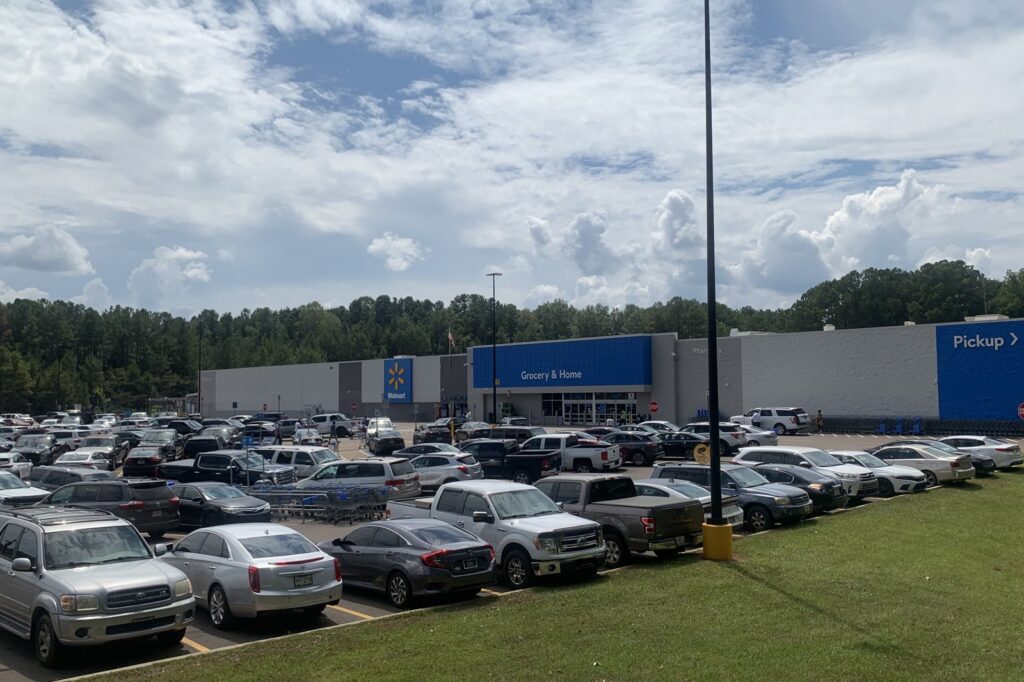
Photo: Ktkvtsh (CC BY 4.0)