
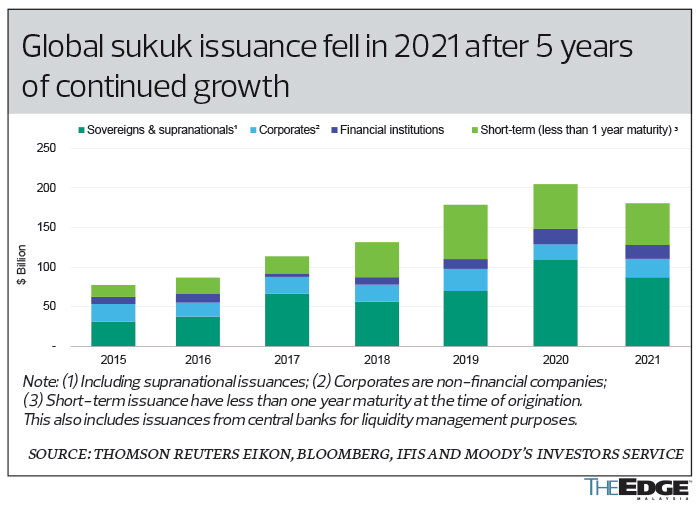
Moody’s Investors Service said on September 7, 2021, that global sukuk issuance will be flat or slightly lower in 2021 after five consecutive years of growth, driven by higher crude prices that reduced financing needs in oil-rich Gulf states. The rating agency reported that first-half issuance rose 3% to $102 billion, propelled by Malaysia and Indonesia, but Gulf issuance fell 19% as Southeast Asian volumes increased 22%. The drop in Gulf Cooperation Council sovereign issuance was the main factor limiting global growth.
Moody’s noted that higher oil prices have eased budget pressures for Gulf governments, reducing their need to tap debt markets. Brent crude has recovered to around $72 per barrel, roughly double the lows reached in March 2020.
“Reduced issuance from GCC governments partly offset the stronger activity in the corporate sector,” Moody’s said in its report. The agency observed that total sukuk issuance for 2021 would likely fall between $190 billion and $200 billion, down from a record $205 billion in 2020. Issuance in the United Arab Emirates and Bahrain dropped 65% to $4 billion in the first half.
The decline was steepest among sovereign and quasi-sovereign issuers that had borrowed heavily during the pandemic.
Southeast Asia drives growth
Malaysia and Indonesia continued to dominate the sukuk market. Moody’s cited their “continued large financial needs” as the primary driver of strong issuance from that region. Southeast Asian issuance rose 22% in the first half, accounting for a growing share of the global total.
The two countries have maintained active borrowing programs to fund infrastructure and social spending. Malaysia, the world’s largest sukuk market, has relied on Islamic bonds to finance its budget deficit.
Indonesia has expanded its sukuk program to attract foreign investors seeking Sharia-compliant assets.
Corporate sector shows strength
Corporate sukuk issuance picked up in the first half, partly offsetting the sovereign decline. Moody’s said stronger activity in the corporate sector was “partly offset by the reduced issuance from GCC governments.” Saudi Arabia’s oil giant Aramco made its sukuk market debut in 2021. The Maldives also entered the market for the first time.
These new issuers helped broaden the investor base. “Acceleration in the issuance of instruments like green sukuk, new issuers and low penetration will bolster the volume,” Moody’s said.
The agency expects the sukuk market to return to its long-term growth trajectory as more issuers and products emerge.
Recovery faces headwinds from Sharia compliance
The COVID-19 pandemic and last year’s historic oil price crash delivered a double shock to Gulf economies heavily dependent on hydrocarbons. Non-oil sectors in the Gulf have begun to recover, but the pace remains uneven. Certain Sharia compliance standards have slowed sukuk issuance from the Gulf.
Sources told Reuters that the adoption of these standards by the United Arab Emirates has created additional hurdles for issuers. The standards require sukuk structures to avoid interest-based elements, which can complicate deal mechanics.
Despite these challenges, Moody’s expects the market to benefit from continued economic recovery, strong investor demand, and better liquidity in debt markets. The agency noted that demand for sukuk has “long outstripped the supply.” The flat year for global sukuk issuance masks divergent regional trends. Gulf states are borrowing less as oil revenues recover, while Southeast Asian issuers and corporate borrowers are filling the gap.
New products like green sukuk and first-time issuers from Saudi Arabia and the Maldives are expanding the market’s reach. Moody’s expects the long-term growth trajectory to resume as these factors take hold.