
Early Life
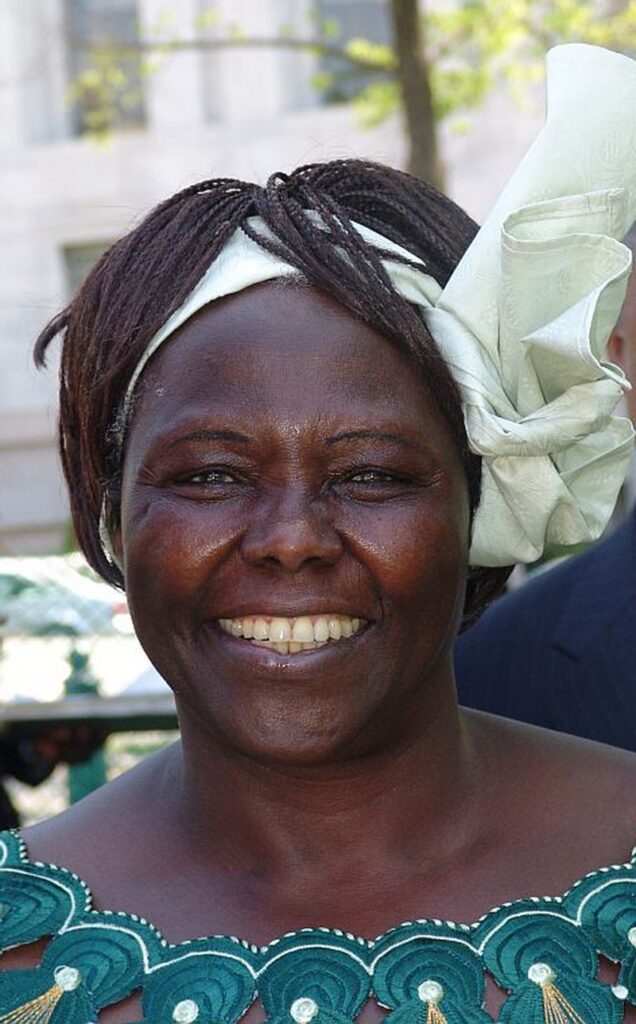
Wangari Maathai was born on April 1, 1940, in the village of Ihithe, Nyeri District, in the central highlands of the colonial Kenya. Her family, Kikuyu, the most populous ethnic group in Kenya, had lived in the area for several generations. In 1943, Maathai’s family moved to a white-owned farm in the Rift Valley near Nakuru, where her father had found work. Around 1947, she returned to Ihithe with her mother, as there was no schooling available on the farm. She joined her brothers at Ihithe Primary School at the age of eight.
When she was eleven, Maathai moved to St. Cecilia’s Intermediate Primary School, a boarding school at the Mathari Catholic Mission in Nyeri. She studied there for four years, becoming fluent in English and converting to Catholicism during her time there.
Education
Maathai’s academic journey continued as a beneficiary of the Kennedy Airlift. She studied in the United States, earning a bachelor’s degree from Mount St. Scholastica College in Atchison, Kansas, and a master’s degree from the University of Pittsburgh in Pittsburgh. She then became the first woman in East and Central Africa to become a Doctor of Philosophy, receiving her Ph.D. from the University of Nairobi in Nairobi, Kenya.
Career and Achievements
In 1984, Maathai received the Right Livelihood Award for “converting the Kenyan ecological debate into mass action for reforestation.” She was an elected member of the parliament of Kenya and served as the assistant minister for environment and natural resources in the government of President Mwai Kibaki between January 2003 and November 2005. She was also an Honorary Councillor in the World Future Council.
As an academic and the author of several books, Maathai was not only an activist but also an intellectual who made significant contributions to thinking about ecology, development, and gender, in addition to African cultures and religions. She died of complications from ovarian cancer on September 25, 2011.
Posthumous Recognition and Legacy
Following her death, Wangari Maathai’s legacy continued to be celebrated both nationally and internationally. In 2010, she was awarded the Presidential Medal of Freedom, the highest civilian award in the United States. Posthumously, she received the United Nations Champion of the Earth Award in 2010 and the Indira Gandhi Prize for Peace, Disarmament and Development in 2011.
Wider Significance
Maathai’s work and activism had a profound impact on the environmental movement, particularly in Africa. Her Green Belt Movement, which she founded in 1977, planted over 50 million trees across Kenya by the time of her death. This not only helped combat desertification and soil erosion but also empowered women by providing them with a source of income through the sale of seedlings and the fruits of the planted trees.
Aftermath
After Maathai’s death, the Green Belt Movement continued its work under the leadership of her daughter, Wanjira Maathai. The organization has expanded its focus to include advocacy for human rights, gender equality, and good governance, reflecting Wangari Maathai’s holistic approach to environmental conservation and social justice.
Sources
– en.wikipedia.org/wiki/Wangari_Maathai
– www.foxnews.com/health/remembering-wangari-maathai-a-global-treasure




